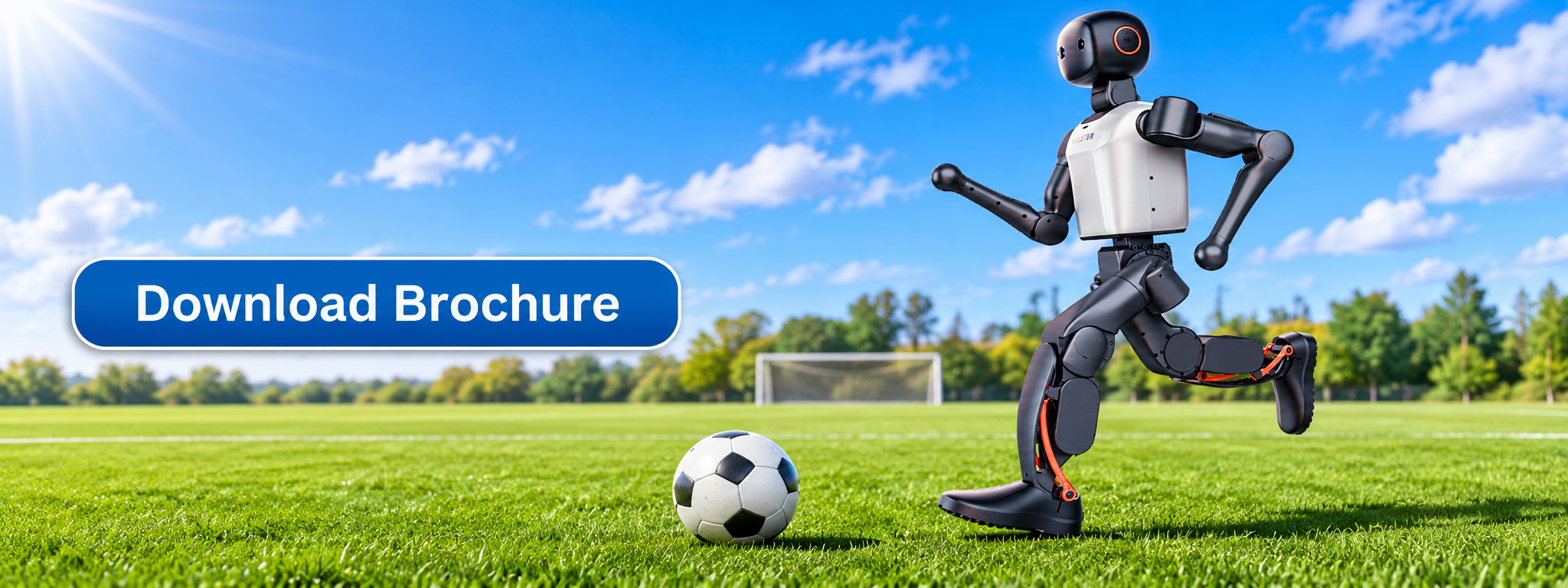
Robotics Education & Humanoid Robot Training
Discover the Future of Robotics and Embodied Artificial Intelligence
Robotics and Artificial Intelligence are transforming the way we live, work and learn. Our robotics education programme introduces learners to the exciting world of Embodied AI, where artificial intelligence moves beyond computer screens and virtual environments to interact with the real world.
Using real humanoid robots, students learn how machines perceive their surroundings, make decisions and perform physical actions. This practical approach brings robotics, coding, engineering and artificial intelligence together in an engaging learning experience.
Designed for schools, colleges and universities, the programme provides a structured learning journey, from introductory visual programming through to advanced robotics engineering and research.
A Practical Approach to Robotics Education
Learn Through Real-World Robotics
Students learn by interacting with real humanoid robots rather than relying solely on virtual simulations. They explore how robots move, sense their environment and respond to different situations.
Develop Practical AI & Coding Skills
Develop valuable programming and engineering skills through visual programming, Python and advanced robotics development tools.
Understand Embodied Intelligence
Discover how perception, planning and action work together to allow robots to interact with the physical world.
Progress from Beginner to Advanced
A structured four-level curriculum allows learners to progress from basic robot interaction to professional-grade engineering and innovative research.
Two Learning Tracks. One Unified Robotics Platform.
The programme offers two complementary learning environments, supporting different ages, abilities and stages of development.
Visual Programming for Schools (K-12)
Designed for younger learners and students who are new to programming. This interactive approach uses visual, drag-and-drop programming to introduce the fundamentals of robotics.
Students learn how to control robot movements, understand sensors and create simple interactive behaviours. They can immediately see how their programming instructions translate into physical robot actions.
Key learning areas: Robot movement, sensing, behaviour, conditional logic and interactive programming.
Booster Studio & Simulation Platform
Designed for students with existing programming knowledge who want to develop more advanced robotics and artificial intelligence skills.
Provides a developer-level toolchain, physics-accurate simulation using MuJoCo, and tools for developing perception, planning and control systems.
Students can develop and test robotic behaviours in simulation before transferring their work to real humanoid robots.
Four Levels of Robotics Learning
The structured curriculum provides a progressive learning pathway, allowing students to develop their knowledge and skills at a suitable pace.
Level 1 – Discovery
8 or 16 lessons
Suitable for beginners with no previous programming experience. Students explore how humanoid robots sense, make decisions and act.
Learning includes safe robot operation, interaction modes and creating simple behaviours using conditional logic.
Example project: Face-aware interaction, allowing a robot to detect a face, wave and speak.
Level 2 – Foundations
8, 16 or 32 lessons
For learners with basic logical thinking and an introduction to flowcharts and Python programming.
Students develop their understanding of the perception, decision and action process, progressing from block-based programming into Python.
Example project: Autonomous obstacle avoidance.
Level 3 – Applied Engineering
16, 32 or 48 lessons
Designed for students proficient in Python who are ready to explore more advanced robotics engineering.
Students develop real-world robotics systems using ROS 2 architecture, integrate visual perception and develop autonomous behaviours.
Example project: Autonomous humanoid soccer player.
Level 4 – Research & Innovation
16, 32 or 48 lessons
For advanced learners with Python or C++ knowledge and an understanding of machine learning and control theory.
Explore learning-based robotic behaviours, reinforcement learning, robotic locomotion and simulation-to-reality development.
Example project: Publishable research or a competition-ready robotics system.
Teacher Training & Professional Development
Successful robotics education requires confident teachers who understand both the technology and how to deliver engaging practical lessons.
The programme includes a structured teacher training system designed to develop classroom confidence, technical knowledge and the ability to deliver robotics education.
1-Day Beginner Training
Develop essential teaching skills and learn how to operate the robotics hardware and software.
Includes: Hardware setup, application controls and no-code programming platforms.
2–3 Day Intermediate Workshop
Build more advanced teaching capabilities, including project-based learning and technical troubleshooting.
Includes: Project-based learning methodology, Python debugging and understanding perception and action.
Advanced Mentor & Certification Development
Develop school-level robotics experts who can support localised training, curriculum development and innovation.
Includes: Curriculum customisation and research guidance.
Ongoing Teaching Support
Access ongoing educational resources to help teachers deliver and maintain effective robotics learning programmes.
Includes: Teaching video libraries, FAQs, troubleshooting manuals and access to an online expert community.
Why Introduce Robotics and Artificial Intelligence into Education?
Robotics education provides an exciting way to introduce students to the technologies shaping the future. By combining practical engineering with artificial intelligence and programming, learners gain experience that goes beyond traditional classroom theory.
- Develop STEM skills: Combine science, technology, engineering and mathematics through practical projects.
- Learn programming: Introduce visual coding, Python and advanced programming techniques.
- Understand artificial intelligence: Explore how intelligent machines perceive, process information and make decisions.
- Encourage problem-solving: Develop logical thinking through real-world robotics challenges.
- Build engineering knowledge: Understand robot movement, sensors, control systems and autonomous behaviour.
- Prepare for future careers: Introduce learners to emerging opportunities in robotics, automation, AI development and engineering.
Take the Next Step into Robotics Education
Whether you are a school looking to introduce robotics into the classroom, a college developing advanced STEM programmes or a university exploring artificial intelligence and robotics research, this structured learning pathway offers an exciting opportunity to develop practical knowledge and technical skills.
Discover how humanoid robotics, artificial intelligence and practical programming can transform the learning experience.
Start exploring the future of robotics today.
Enquire About Robotics Training